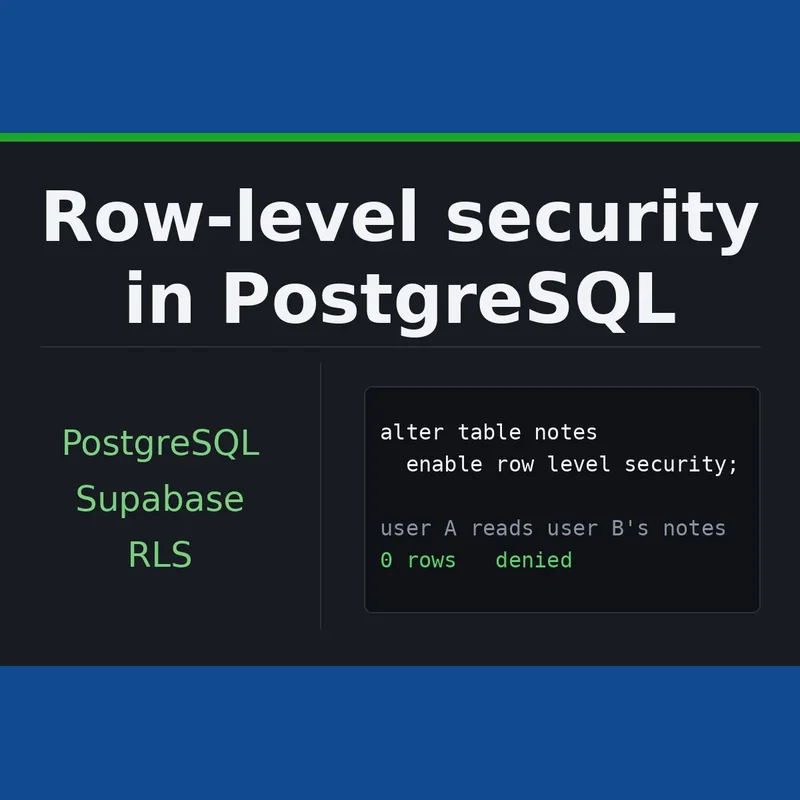
When every logged-in user can technically read anyone's rows, your application is the only thing stopping them. We build the access rule directly into PostgreSQL using row-level security policies and dedicated roles, then write tests confirming that one account cannot touch another account's data.
Starter
- Review of up to 5 tables
- Written report of gaps found
- Example queries showing each issue
- 1 revision
Standard
- Policies and roles built across up to 10 tables
- Written report
- Example queries
- Tests proving the rules hold
- 2 revisions
Advanced
- Coverage of up to 25 tables
- Plan or tier limits enforced inside the database
- Migrations and automated tests run in CI
- Written report
- Example queries
- 3 revisions
Any product with user accounts, paid tiers, or multiple teams sharing one database faces the same question: who is allowed to see which rows. When that logic sits only in application code, it collapses the moment data is reached another way - an unguarded new endpoint, a second service on the same database, or an auto-generated API. Placing the rule inside PostgreSQL itself, next to the data, removes that single point of failure.
We have built this pattern for a subscription product under a non-disclosure agreement: row-level security policies on the tables plus a distinct database role per subscription tier, so entitlements are enforced by the database engine rather than by code someone could skip.
With Starter, we examine the policies already present or missing across up to 5 tables and hand over a written list of gaps, each backed by an example query that demonstrates the issue. Standard builds or corrects policies on up to 10 tables, sets up the roles your application needs, delivers them as migration files, and adds tests where one user tries to read or alter another user's rows and is blocked. Advanced scales to 25 tables, adds plan or tier limits enforced within the database, and runs the full test suite inside continuous integration.
On Supabase-style setups the same PostgreSQL mechanics apply, drawing on auth.uid and JWT claims inside the policies. On plain PostgreSQL, policies instead read the current user from a session variable your backend sets per request.
There are no calls involved. Every package finishes with a plain-language summary of who can see what; Standard and Advanced also include the policies as migration files in your repository, alongside the tests. For 14 days following delivery, we correct anything that does not match what was agreed, at no extra cost.
How the work proceeds:
1. Mapping the data - we list every table, who owns each row, and who should be able to read or change it across owners, team members, admins and each plan.
2. Auditing the current state - existing policies, grants and roles are checked against that map, with every gap documented and demonstrated by a query.
3. Writing policies and roles - rules are built per table and per action, with roles for plans or teams, delivered as reviewable migration files.
4. Verifying with tests - automated checks log in as different users and attempt to read or change each other's data; forbidden actions must fail and permitted ones must succeed.
5. Handover - a short plain-language note on who can see what, the migration files, and guidance for adding policies when new tables are introduced.
What happens after you buy
Your order opens its own thread here the moment it is paid, and everything about that
order - questions, changes and the final report - happens in it.